Normalizes
Proprietary LIMS exports, HL7, FHIR, VCF, flat files, mapped into a shared semantic layer (OMOP, CDISC, FHIR) so datasets can actually be joined.
Biobase sits between the systems that hold clinical data (EHR, LIS, PACS, biobanks, billing) and the researchers who need it, as one governed layer.
Proprietary LIMS exports, HL7, FHIR, VCF, flat files, mapped into a shared semantic layer (OMOP, CDISC, FHIR) so datasets can actually be joined.
Pathology, imaging, molecular, and outcomes data linked at the patient level, across institutions, without the data needing to leave its home.
Every specimen, slide, and record becomes discoverable, searchable by research intent, not by knowing which server it sits on.
Governed, compliant access between the institutions that hold clinical data and the researchers who need it.
Find blocks, slides, and images using search that understands research intent and dataset attributes, then move from discovery to a compliant order in the same workflow.
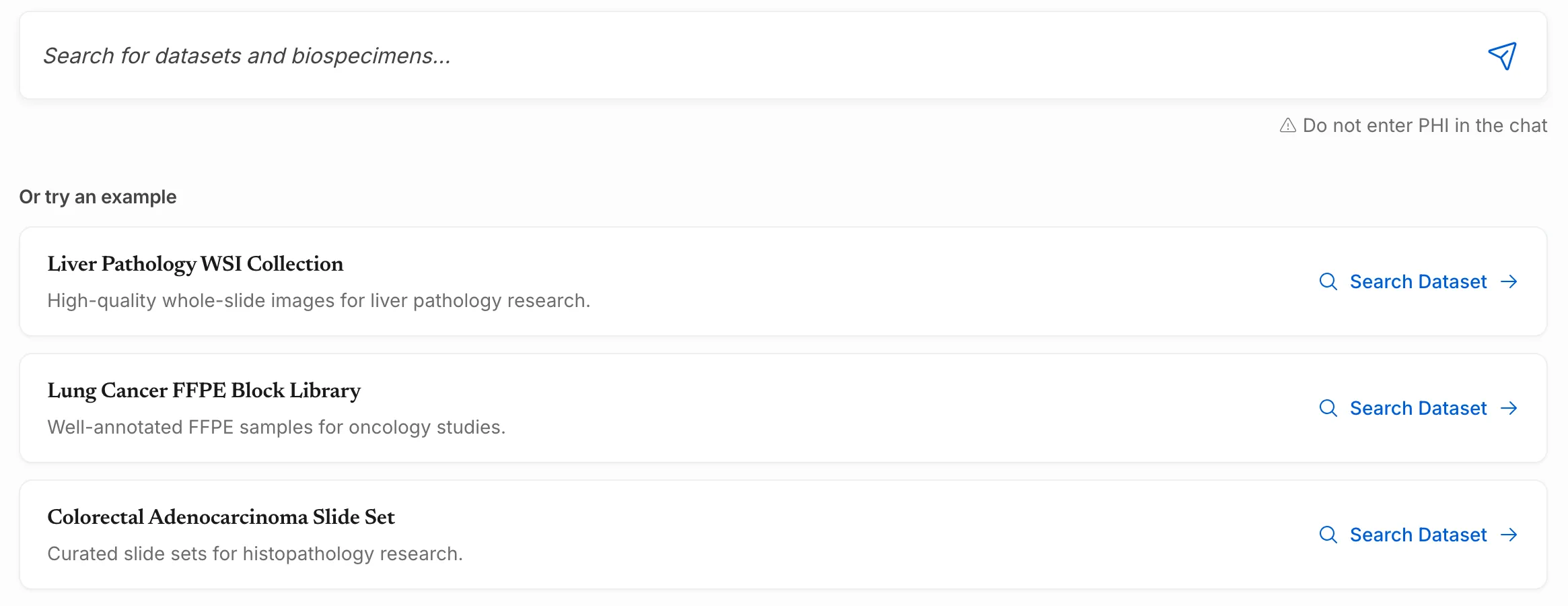
Ask for the cohort you need in plain language. Biobase translates research intent into queries across connected datasets.
Data stays where it lives. Institutions keep custody; the network provides discovery, normalization, and governed access.
HIPAA-aligned de-identification, lineage, and audit trails are part of the pipeline, not bolted on afterward.
Pathology, imaging, molecular, and outcomes data linked at the patient level and delivered research-ready.
AI agents handle cohort building, feasibility, and procurement, with a human in the loop for every consequential action.
Match patient populations to trial criteria across the network, from feasibility through site selection.
One governed layer between clinical data and research.
Biobase sits between the systems that hold clinical data (EHR, LIS, PACS, biobanks, billing) and the researchers who need it. It normalizes data into a shared semantic layer, links pathology, imaging, molecular, and outcomes data at the patient level, indexes it by research intent, and governs access.
OMOP, CDISC, and FHIR.
Biobase accepts proprietary LIMS exports, HL7, FHIR, VCF, DICOM, flat files, and PDFs, so datasets from different institutions can be joined and queried together.
No, it doesn't need to leave.
Biobase matches the integration method to each institution's needs and compliance posture. In a federated connection, the network carries queries and governed results rather than copies of the archive.
2 weeks
from request to delivery
against 12 months of dead ends
Traditional channels had turned up no rare-disease samples. Biobase delivered the cohort, and 8 reorders followed in the next two months.
3 weeks
to onboarded and contracted
against a 9-month standard
Data-supplier quality and provenance were the problem. Biobase was onboarded as a vendor and the contract signed.